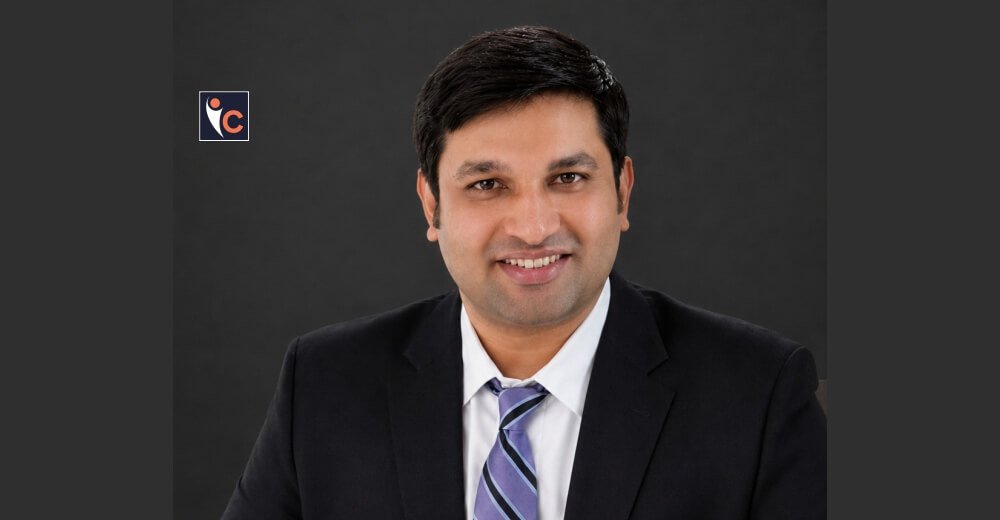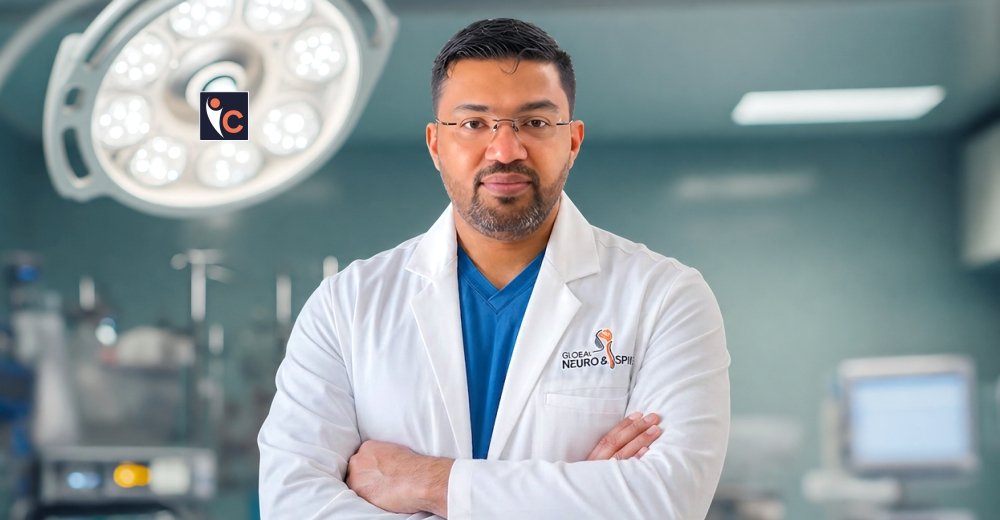
The complex field of neurosurgery requires Dr. Hardik Rajyaguru to make critical decisions that have the power to change patient outcomes. He has established his professional reputation through his combination of medical expertise and ability to overcome challenges, and his dedication to helping patients. His professional career displays his dedication to enhancing neurological treatment, which he developed through years of demanding medical education. He established himself as a leading expert in brain and spine disorder treatment through his work as Director and Neurosurgeon at Global Neuro and Spine Care Pvt. Ltd. where he provides accurate and compassionate patient care.
He developed his career because of his strong desire to study the human nervous system, together with his determination to achieve the highest standards in his field. Throughout his career, he has adopted new medical technologies while keeping his focus on patients. He develops clinically effective treatment methods that he delivers to patients in a compassionate manner. His work creates new methods for patients to receive healthcare while developing trust, which helps to improve healthcare outcomes for patients and their families.
A Platform Born Out of Personal Pain
When Dr. Rajyaguru completed his MBBS at Pramukh Swami Medical College and then pursued a fellowship in Endoscopic Brain and Spine Surgery at the Apollo Institute of Neurosciences, Chennai, where he trained from 2011 to 2017 he carried with him a singular conviction: quality neurosurgical care must not be a privilege of geography.
After stints at BJ Medical College, Ahmedabad, and as a consultant at IQ City Medical College Hospital in Durgapur, West Bengal, he founded Global Neuro and Spine Care Pvt. Ltd. — not as a conventional hospital chain, but as a health-tech platform that connects the right neurological patients to the right neuro specialists. The model, lean and digitally powered, targets the precise geography that mainstream healthcare routinely ignores.
“There is a huge gap in medical care in India between metro cities and tier-3 cities or smaller places. I myself and my family suffered that. We didn’t have direct access to neuro care. So that’s why I envisioned Global Neuro and Spine Care,” he explains. Today, the platform actively operates across West Bengal, Bihar, and Jharkhand three states that account for a vast swathe of India’s neurologically underserved population. The vision ahead is Pan-India replication.
The Science of Leaving the Ego at the Door
Ask any experienced neurosurgeon what separates a good outcome from a great one, and the answer rarely involves just technical skill. Dr. Rajyaguru offers a candid, almost counterintuitive philosophy: the patient’s comfort, not the surgeon’s achievement, defines a successful procedure.
He walks through a scenario that many surgeons face, but few discuss openly. A patient presents with a complex brain tumor. Removing it entirely would produce a clean post-operative scan, a result that gratifies the surgeon’s ego. But complete resection might also leave the patient disabled, transforming them into a social and economic burden on their family. In such a case, he chooses radiosurgery, a non-surgical, X-ray-based treatment that keeps the patient functional and independent, even if it doesn’t deliver the surgical ‘win’.
“My personal interest takes the back seat here. We always prioritize the comfort of the patient and the family. Everything else is secondary,” he says plainly. It sounds straightforward, but in a specialty notorious for its high-stakes decisions and formidable egos, this patient-first framework is both radical and quietly courageous.
Keyhole Surgery in Tier-3 India: Technology Without the Burden
A decade ago, the notion of performing advanced neurosurgery in India’s smaller cities was largely aspirational. High-end microscopes, neural navigation systems, endoscopes, and high-speed drills lived almost exclusively in urban super-specialty hospitals. Peripheral towns made do with what they had, which was often far too little.
Dr. Rajyaguru’s team deliberately dismantled that geography of privilege. He now personally uses neural navigation, high-speed drills, CUSA (Cavitron Ultrasonic Surgical Aspirator) machines for tumor removal, and endoscopes, all within a tier-3 setting. His practice has progressively shifted toward minimally invasive techniques, including what he calls “keyhole spine surgery,” a procedure performed through an incision of just 7 millimeters. The platform delivers these capabilities to patients who never had reason to expect them outside a metropolitan center.
“We are not creating any economic burden for our patients. Yet we are delivering this to them. It is kind of way ahead of time in the periphery,” he says. The clinical results bear this out: shorter recovery periods, lower infection risk, and outcomes that align with international standards without the patient having to pack a bag for Mumbai or Delhi.
Breaking a Mindset, One Surgery at a Time
Dr. Rajyaguru does not romanticize the path he has walked. He acknowledges that the greatest obstacle his organization encountered was not infrastructure or funding; it was belief. Decades of systemic imbalance had hardwired patients, families, and even healthcare workers to assume that good neuro care could only exist in big cities. Changing that mental map required sustained proof, not persuasion.
“People always had that mindset that better neuro care is available only in big cities. Their brains were programmed that way,” he reflects. Recruiting quality care providers for peripheral locations proved equally difficult, another symptom of the same cultural conditioning. But the team persisted. As successful surgeries accumulated and stakeholders observed consistent, impactful results, trust began to build organically.
A similar skepticism met the platform’s digital dimension. Investors and peers at startup meet questioned how a specialty as complex as neurosurgery could function on a health-tech model. Neurological care, they argued, demands a one-to-one, in-person dynamic. He, along with his team, stood by their model, letting outcomes answer the doubters. The argument is now largely settled.
Ethics by Design, Not by Constraint
India’s healthcare sector grapples with a persistent critique: commercialization has eroded the sanctity of patient care. Dr. Rajyaguru’s counter is structural rather than rhetorical. By building Global Neuro and Spine Care on a low-debt, low-overhead model, the organization eliminates the financial pressure that often drives unethical practice in the first place.
“We have reduced the cost of providing quality care. Once your own costs are lower, you don’t have to do anything unethical. Some entities are under great constraints, and out of that compulsion, they might indulge in those things. For us, that was never a challenge,” he explains. Patient-centric practice, he insists, is not a policy the organization follows; it is its default setting.
This philosophy also extends to his public presence. On LinkedIn, where he engages with India’s medical community, he raises uncomfortable questions about training standards in neurosurgery, challenging unregistered fellowships, decrying the use of fellows as cheap surgical labor, and pushing for structured pathways that produce genuinely competent spine surgeons. He is, in other words, not merely building a practice; he is advocating for the integrity of his entire profession.
The Decade Ahead: Ageing Spines, Rising Roads, and a Vision for Equity
When Dr. Rajyaguru scans the horizon of India’s neurological health landscape, he identifies three converging crises that will define the next decade: a rapidly aging population whose degenerating spines demand specialized geriatric care; a surge in road traffic accidents driven by India’s explosive vehicle growth; and a troubling rise in strokes among younger adults. Each trend points toward a single, urgent conclusion: the country needs far more accessible neuro and spine care than it currently provides.
His response draws on a disarmingly everyday analogy. “If you eat a pizza at Domino’s in a metro city and then walk into the same outlet in a tier-3 city, the ingredients and the process are the same. The taste is about 80% identical. That is standardization. If we can do that for a pizza, we can do it for spine surgery as well. It should be our priority as a country.”
Standardization of care, delivering the same protocol and quality regardless of whether the patient lives in Kolkata or Khagaria, is the north star of Global Neuro and Spine Care’s expansion roadmap. The platform already delivers international-standard results in West Bengal, Bihar, and Jharkhand. Replicating that model, Pan-India is not merely an aspiration; for him, it reads as an obligation.
A Message to the Next Generation and to All of Us
To aspiring neurosurgeons, Dr. Rajyaguru offers two clear directives. First, prioritize patient welfare above everything else; the rest will follow. Second, abandon the assumption that good medicine can only happen in large cities. “Healthcare is peripheralizing,” he tells his own team regularly. Tier-2 and tier-3 cities post maximum growth. The physicians who plant themselves there now will not just find patients, they will find purpose.
For the general public, he reserves a message that is both practical and characteristically unpretentious. “Sitting is the new type of smoke,” he says. Prolonged sitting damages the spine. He urges everyone to maintain an upright posture, take a two-to-three-minute walking break every 25 to 30 minutes, and practice Bhujangasana, the cobra pose, as a daily spinal exercise. Wearing helmets and seat belts rounds out his prescription.
That simplicity, in the end, is Dr. Hardik Rajyaguru’s signature. He operates one of India’s most technologically advanced peripheral neurosurgery platforms, pushes for systemic reform in medical training, and performs complex brain and spine procedures that most surgeons reserve for urban super-specialty hospitals and yet he describes his mission in terms a schoolchild could understand. Close the gap. Keep the patient safe. Trust is earned, not declared.
He sees himself, in his own words, “at a milestone in a journey” with a long way still to go. For the patients in West Bengal, Bihar, Jharkhand, and the many states yet to come, that journey cannot arrive fast enough.
For Consultations or Inquiries, Contact: +911 9721108108