Prime Highlights :
- Department of Pharmaceuticals and FICCI open the ninth India Medical Device conference in New Delhi, positioning India as a global hub for quality medical devices.
- Government leaders press for an export-driven, domestically manufactured medical device industry to build supply-chain resilience and global competitiveness.
Key Facts :
- India’s medical device market sits near 16 billion dollars against a global market topping 600 billion dollars.
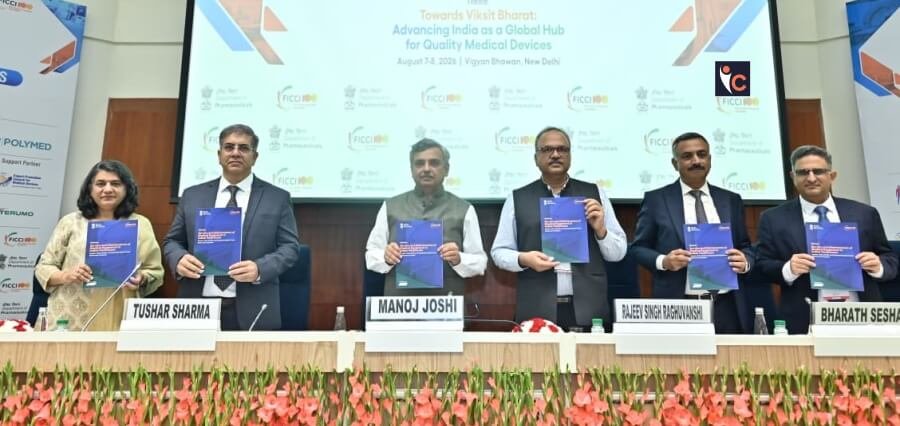
- Conference marks release of a white paper on strengthening service and maintenance of medical equipment nationwide.
Background :
New Delhi hosted the opening session of India Medical Device 2026, the ninth edition of the conference, at Vigyan Bhawan, drawing policymakers, regulators, industry leaders and innovators focused on building up the country’s medical devices sector.
The Department of Pharmaceuticals, under the Ministry of Chemicals and Fertilizers, ran the two-day event alongside FICCI, with sessions built around positioning India as a global hub for quality medical devices as part of the Viksit Bharat push.
Department of Pharmaceuticals Secretary Manoj Joshi opened proceedings by urging the industry to build export capacity rather than rely solely on the domestic market. Local manufacturing, he said, generates jobs, builds technical capability and shields supply chains from disruptions elsewhere in the world.
Joshi credited India’s progress in consumables, disposables and assembling advanced diagnostic and imaging equipment, then pressed for more value addition at home, wider component manufacturing and tighter quality benchmarks.
He put India’s medical device market at roughly 16 billion dollars, a fraction of the more than 600 billion dollar global market, and argued the country needs tighter links to global value chains plus closer ties between startups and established manufacturers.
Drugs Controller General of India Rajeev Singh Raghuvanshi said the industry is shifting away from imports toward homegrown manufacturing. He pressed for stronger domestic capability in high-end Class C and Class D devices, in-vitro diagnostics and quicker, more predictable regulatory clearances.
Abbott Healthcare’s Tushar Sharma, FICCI Director General Jyoti Vij and Philips Indian Subcontinent’s Bharath Sesha each pointed to growing investment in research, manufacturing and workforce training, framing these as signs India could become a genuine MedTech leader.
Organizers also used the opening day to release a white paper on strengthening how medical equipment gets serviced and maintained across the country.