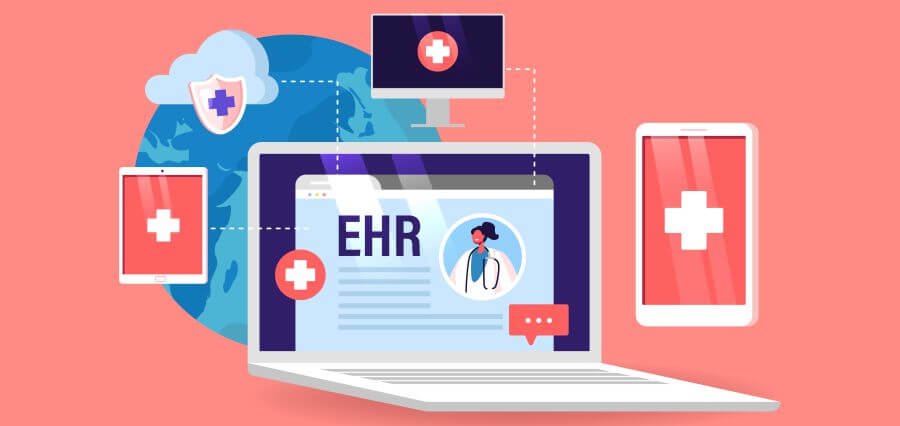
Initially, the whole business of healthcare used to be done in the most inefficient and outdated way imaginable. In less than 20 years, this landscape has been completely changed by the use of EHR (Electronic Health Record) systems. Stacking papers and files, doing manual entries, and maintaining records have been replaced by digital platforms that guarantee quick and easy patient care. Consequently, practitioners from tiny clinics to Ivy League hospitals unanimously agree that it is not only convenient but also necessary to have a digital record system that is reliable and rather easy to maintain. Switching to EHR is not merely an upgrade; it is a deal with the accuracy, efficacy, and ultimately the patient’s safety.
The significance of health records going digital keeps on growing, mainly because it has the potential to integrate even a patient’s medical history. Try picturing a physician being handed the entire history of a patient’s lab results, prescriptions, allergies, and hospital access—right at the click of a mouse. No doubt, sheer accessibility can become a factor in the saving of lives, and that precisely is the reason why adoption is being embraced frantically.
The Rise of EHR Systems in Healthcare
The evolution of EHR systems results from their function as digital counterparts to the standard paper medical records. They are, however, no longer just a digital filing system but have become technologically advanced healthcare solutions with features such as automation, data analysis, and remote accessibility. Through this, the health care workforce can not just document the interactions but also answer inquiries and make better clinical decisions.
The movement towards compatibility and standardization at the global level has encouraged the extent to which the EHR systems are being implemented. Transforming tools that can close the gap between different networks and institutions in hospitals, clinics, and even individual professionals are where these systems are counted. With the open access to data among health staff, it is ensured that a patient is being attended to in the best way even when the doctor-in-charge does not have full information about the case—a problem that changing to paper records would have made.
How EHR Systems Improve Patient Care
The EHR systems have brought in a number of new advantages, and one such is the way they make the patient outcomes better. In fact, one can hardly find any doctor that is not equipped with an EHR system or that still uses paper records. Having access to the latest data enables physicians to easily steer clear of making critical errors, as they may give a patient the wrong medicine or inject the one that interferes with the drug they’re taking. This form of correctness raises the level of the patients’ safety, and at the same time, it instills a sense of confidence among doctors in their judgments.
Apart from safety concerns, the availability of managed digital records significantly contributes to enhancing the patient experience. Patients avail themselves of quick diagnoses, undergo less duplication of tests, and are referred to specialists easily with the help of organized digital records. When the flow of information, which is still kept secure, among providers is fast, patients spend less time waiting and more time receiving the care they need. To put it simply, EHR systems become a journey through the healthcare system that is not only client-centered but also more coordinated.
EHR Systems and Efficiency in Practice Management
Time is a very valuable resource for the providers of healthcare. One hour, in which the staff is engaged in manual documentation, is a lost opportunity for direct patient care teamwork. A feature like automated billing codes, e-prescriptions, and integrated scheduling systems can be a convenient way to conduct administrative tasks in a time-efficient manner by using EHR systems.
This development in efficiency is also reflected in financial benefits. The centers, as well as the hospitals, which are at the forefront of implementing the advanced EHR systems, often cite their cost savings in connection with the reduction of paperwork, the decrease in the number of billing errors, and the speeding of the claim process. New York-based medical staff can, therefore, focus on the care of patients instead of being mired in complex insurance codes and endless forms.
Data Analytics and Predictive Power
More notably, a crucial feature for the success of EHR systems is their capacity to exploit data analytics. They are not merely storage mediums; they are one of the most accessible and powerful resources for data mining and getting instant awareness. By adopting advanced reporting and real-time analytics, EHRs that once seemed silent are now reporting, predicting, and managing the patients’ health conditions over time.
For example, the physician can be cautioned well in advance by the predictive clinical analytics incorporated into the EHR system when a patient is liable to diabetes, heart diseases, or any other similar disorders. The cause of the disease should be identified well in advance to prevent terrible consequences and promote the patients’ well-being. To be sure, this is the moment when the medical industry becomes truly futuristic, which means it moves from reactive to preventive care.
Accessibility and Interoperability in EHR Systems
A major obstacle that health care has to face is the lack of an easy and safe way to exchange the information. The same patient might go to different doctors in the middle of a medical journey, and this will have the effect that his data will be scattered in different places. This, however, will be solved by the electronic health records system, which aims at making it possible that data can travel smoothly and easily not only to doctors but also to specialists, pharmacies, and laboratories.
The accessibility brought about by this system is the snapper bonus of the patients. A lot of the EHR systems nowadays have patient portals, which allow testers to check their results and speak with their doctor in a secure and confidential manner, as well as keep a record of their health history. Transparency leads to a stronger connection between a doctor and a patient, which improves the quality of medical care provided to patients, who in turn become more active participants in their own care.
EHR Systems in the Age of Telehealth
Over time, telemedicine’s progress has indeed increased the call for improved digital records of patients. Without a reliable digital system, it would be almost impossible to keep track of patients’ history and execute virtual appointments. Telemedical platforms now are more compatible with electronic health record systems, letting doctors do everything, like file updating and documentation, without affecting security.
Remote care is an ever-changing form, with the position of EHR systems always being to establish the link between the patients and the doctors separated by the geographical zone. It does not matter if it is a specialist consultation from the other side of the world or a simple video call with a local doctor; electronic health records make sure that the streamlines underpinning every digital communication are accurate and reliable.
Challenges and Future Outlook of EHR Systems
Despite the benefits that seem compelling, the adoption of EHR systems is not without problems. The issues of data security, extremely high implementation expenditures, and training requirements, which might slow down the pace of integration into the current workflow, are just a few examples of the bottlenecks that pertain to EHRs in health care providers’ offices. Providers, on the other hand, need to strategically and skillfully manage these barriers while endeavoring to reap the long-term benefits and create efficient and effective outcomes.
Looking beyond this point, coupled with blockchain and machine learning, artificial intelligence can be the main fuel for the further improvement of EHR. This will be the case if AI-based healthcare prediction models can only be accurate in reading huge bulk data sets coming from electronic health records providers. In the meantime, blockchain might be creating reliable, virus-free patient data records by being the most impregnable security system.
What remains to be seen is whether, or maybe even how, EHR systems are still turned into optional, hitherto unnoticed health care components. In fact, things are pretty much the opposite. They constitute the core of a system that is struggling to be more patient-centered, accurate, and efficient. The healthcare organizations’ capacity to efficiently use and continuously improve them would be a sign that they are able to keep up with patient demands and technological breakthroughs.