Prime Highlights-
- Union Minister Dr Jitendra Singh says India is emerging among the front-line providers of AI-guided, gene-driven precision medicine.
- He urged young doctors to pair new technology with sound clinical judgement and to make prevention of lifestyle diseases a national priority.
Key Facts-
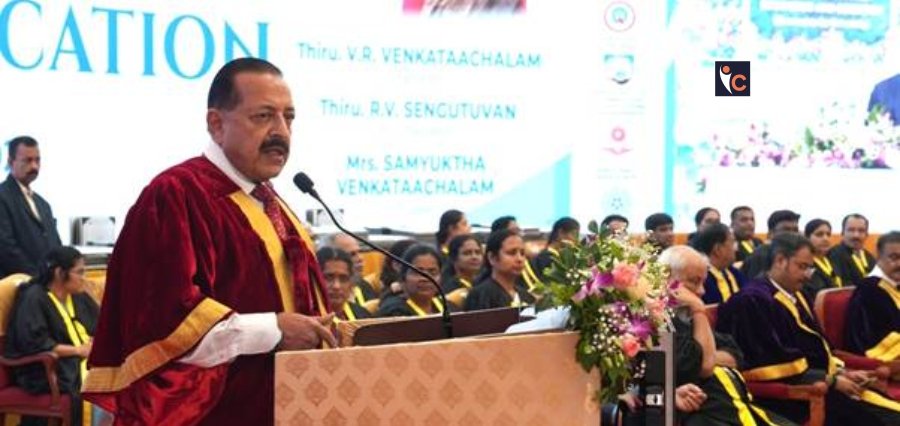
- Singh spoke as chief guest at the 42nd Convocation of Sri Ramachandra Institute of Higher Education and Research (SRIHER), Chennai.
- He cited India’s indigenous COVID-19 DNA vaccine, haemophilia gene therapy and the antibiotic nafithromycin as examples of homegrown research strength.
Background-
Union Minister Dr Jitendra Singh said on Thursday that India is taking a leading role as medicine turns to artificial intelligence and gene-based care.
He addressed graduates as chief guest at the 42nd convocation of Sri Ramachandra Institute of Higher Education and Research (SRIHER). Chancellor V. R. Venkatachalam and Pro-Chancellor R. V. Singhrutawar attended.
Singh, a professor of medicine and diabetes, told the new doctors that technology will assist them, but sound clinical judgement must stay at the heart of care.
Drawing on nearly four decades as a clinician, he said doctors now see diabetes and heart disease in younger patients. He urged stronger prevention and early care, since someone who develops diabetes at 30 may live with it for decades. Healthy youth, he added, will power the Viksit Bharat 2047 goal.
He highlighted Indian research strengths: an indigenous COVID-19 DNA vaccine, dengue and malaria vaccine work, haemophilia gene therapy, the antibiotic nafithromycin for community-acquired bacterial pneumonia, and nuclear medicine studies on leukaemia and fatty liver disease.
Singh invited SRIHER to join national projects in genomics, biomanufacturing and nuclear medicine. Teamwork among government labs, universities, hospitals and industry, he said, can speed up affordable treatments.
He added that linking genetic data with patient outcomes will help doctors tailor care to each person’s genes, lifestyle and surroundings.
He also wished Vice-Chancellor Dr Uma, who missed the event, a speedy recovery.